
Selecting a home-use beauty device is not only a question of choosing a popular technology. The right product has to fit the intended user, treatment area, sales channel, target price, market requirements and after-sales plan. A device that suits an e-commerce launch may need a different format, accessory set and packaging approach from one intended for retail chains, distributors or professional beauty partners.
This guide gives buyers and product teams a practical framework for narrowing the options before requesting samples or quotations.
1. Define the user, market and sales channel
Start with a short product brief. Identify the target country or region, intended user, retail price range and primary sales channel. These decisions affect the product format, documentation, packaging, accessories and level of customization that may be practical.
- E-commerce: compact packaging, clear visual demonstration and simple operation are often priorities.
- Retail: shelf presentation, multilingual materials, barcodes and consistent replenishment may matter more.
- Distributor projects: territory requirements, documentation, spare parts and training materials should be discussed early.
- Professional channels: operating procedures, durability, accessories and service planning usually require closer review.
2. Choose the treatment area and product format
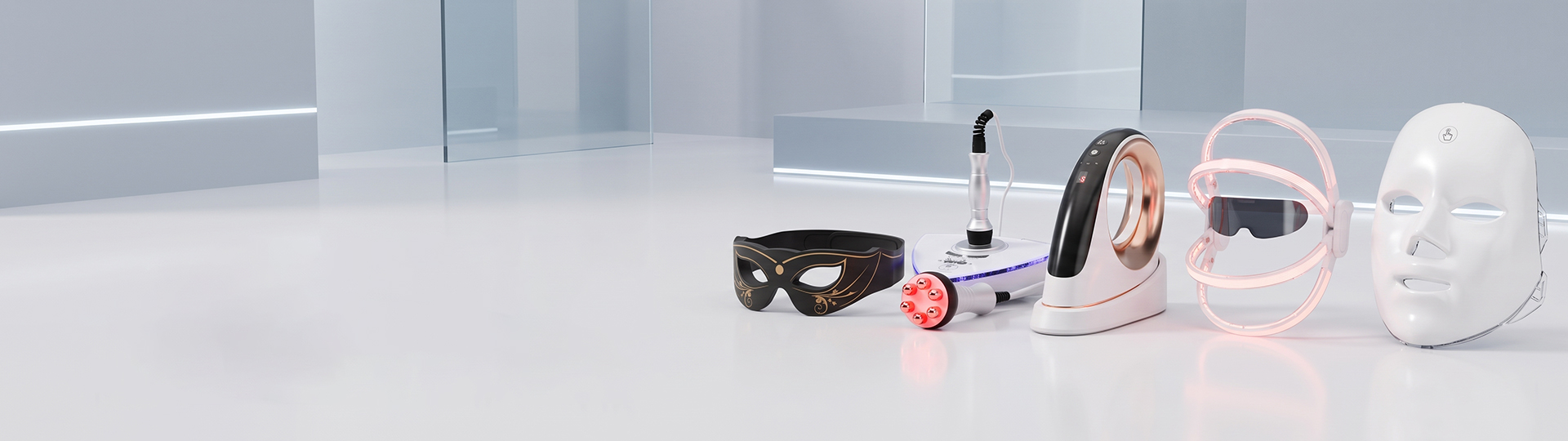
Define whether the product is intended for face care, body care, eye care, scalp care or a combined routine. Then decide how the customer will use and store it: handheld device, mask, cap, panel, tabletop unit or floor-standing system.
Do not compare technologies before this step. A technically attractive device can still be unsuitable if it is too large, too complex or difficult to explain in the intended channel.
3. Match the technology to the product concept
Technology should support the intended format and positioning. Common directions include:
- LED light: available in facial, eye, scalp and larger panel formats. Confirm the actual wavelength configuration, output parameters, timer and operating instructions for the selected model.
- RF and EMS: used in selected face- and body-care concepts. Confirm intensity levels, contact method, control logic and sample performance.
- Hot and cold care: relevant for targeted facial routines. Review the operating temperature range and protection design.
- Ultrasonic, vacuum and massage: available in selected face- and body-care products. Check the included heads, consumables and cleaning requirements.
Avoid building the product brief around benefit percentages or medical-style claims unless the exact claim is supported by appropriate evidence and is permitted in the destination market.
4. Compare specifications, not only feature names
Two devices described with the same technology can differ significantly. Ask the supplier to confirm the specification of the exact model and sample rather than relying on a category-level description.
- Model number and version
- Power input, charging method and battery information
- Operating modes, intensity levels and timer
- Materials, product dimensions and net weight
- Included accessories and replacement parts
- Available colors, logo methods and packaging options
- Available test reports or certificates for the exact model
5. Review samples with a repeatable checklist
Use the same checklist for every sample so the comparison is consistent. Record the packaging condition, appearance, controls, mode changes, charging, accessories, instructions and any noticeable variation between units. If a feature or specification is important to the purchase decision, include it in the approved specification rather than leaving it only in email or marketing copy.
For a new supplier, a sample is also an opportunity to evaluate response time, specification accuracy, change control and the clarity of the production process.
6. Confirm compliance for the destination market
Compliance is model- and market-specific. Share the intended country, sales channel and required claims with the supplier. Request the available documents for the exact configuration, and have the final product, label, manual, packaging and marketing claims reviewed against your market requirements.
See Hayssa’s quality and certification information for the inspection and document-confirmation approach.
7. Decide between an existing model and a development project
An existing model with branding, color, packaging or accessory changes is usually the more direct route for testing a market. A broader ODM project may be appropriate when the required appearance, functions or user experience cannot be achieved with an available platform.
Compare the two routes in the OEM vs ODM beauty-device guide, or review Hayssa’s OEM/ODM process.
8. Prepare the information needed for a useful quotation
Before contacting a manufacturer, prepare the target market, sales channel, preferred model or product direction, expected quantity, desired timing, branding requirements, packaging language and any required documentation. This reduces repeated clarification and makes quotations easier to compare.
If you are evaluating an existing Hayssa model, browse the beauty-device range and share the relevant model number with the project requirements. For a new project, contact the Hayssa team with the intended functions, appearance direction and development scope.